Monday, 22 February 2016

LINQ Operator in C#


LINQ stands for Language Integrated Query and is Microsoft’s advanced data access technology that is used to query collections of data.


The collections can be of two types:


1.  local collections such as collections belonging to the System.Collections namespace  and the              System.Collections.Generic spaces

e.g.       List<T>,Dictionary, HashSet etc


2.  Other collections are remote collections such as an XML document or a database table

Syntax of LINQ
There are two syntaxes of LINQ. These are the following ones.

·         Lamda (Method) Syntax
Example
var longNames = Names.Where( n => n.length > 10);


·         Query (Comprehension) Syntax
Example
var longNames = from n in Names where n.length > 10;


Monday, 1 February 2016

How to return NULL value from generic method in C#

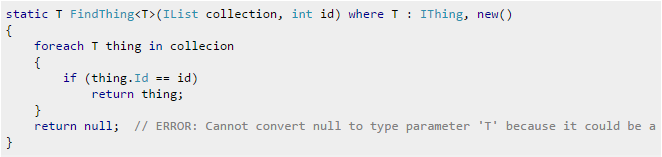
Following  my Example code for describe the issue,

following i have written the generic method to Search thru the list by using given search value
if value in list return the list and otherwise return NULL Value.


According to the code it seems ok.but it get following error

Cannot convert null to type parameter 'T' because it could be a value type

For avoid that issue following option

1- Method

Return default(T) which means you'll return null if T is a reference type (or a nullable value type), 0 for int, '\0' for char etc

2- Method
Restrict T to be a reference type with the where T : class constraint and then return null as normal


Monday, 19 October 2015

How to Modified a Collection During in Iteration in C#

When we use Collection in our code , sometime we need to modify (delete) collection
during the Iteration. but we can't remove element directly from collection during the Iteration.
when we  do we got following Exception.

"Cannot Modify a Collection While It Is Being Iterated"


It can solve many ways in this article describe two ways to solve that  

1.Using temporary  List.
2. Can Iterate backward.

Using temporary  List

To describe this method as an example i get source Collection as customerList which the list we want to delete team during iteration. 


var tempList = customerList;      //sourceList
foreach (var item in customerList)
{
    if (item == "Bunny")       // Condition to remove Element
   {
        tempList.Remove(item);
    }
    customerList = tempList;
}


In this way, we didn't modified original collection during the iteration. for that  this method use temp collection for the modification during the iteration and finally assign  that value  to original collection.


Can Iterate backward

To describe this method as an example i get source Collection as customerList which the list we want to delete team during iteration as previous.


for (int i = customerList.Count - 1; i >= 0; i--) {
  if (customerList[i] == something) { // condition to remove element
     customerList.RemoveAt(i);
  }
}


Friday, 28 August 2015

SOLID Principal in C#


Solid principal is contains five basic principal  of OOP  and design to create good software architecture.By using these basic principal we can design, create a system that can easily maintain and extensible over time.It is part of an overall strategy of agile and adaptive programming.

SOLID is an acronym where
  • S: Single Responsibility Principle (SRP)
  • O: Open closed Principle (OSP)
  • L: Liskov substitution Principle (LSP)
  • I: Interface Segregation Principle (ISP)
  • D: Dependency Inversion Principle (DIP)


Single Responsibility Principle (SRP)